
Bamberg's city marketing department has received numerous awards, and Klaus Stieringer was named "German Cultural Manager of the Year 2014." During a tour of Bamberg, he impressively explained to the Brand Club how to manage a World Heritage city and transform it into Germany's most event-oriented city.
How did Bamberg become an attractive cultural destination?
The initial goal was to attract a discerning and affluent target group, and a highly scientific approach was adopted. Beyond the usual target groups, careful consideration was given to precisely who the city wanted and who it didn't. The aim was to discover what motivated these individuals and what they enjoyed doing: "What kind of music does each target group listen to? The chair in Regensburg recommended jazz to appeal to high earners, academics, and people willing to travel longer distances." An intriguing approach to targeting people.
„And so, for the past 13 years, we’ve had a large blues and jazz festival, free of charge thanks to our sponsors,“ Klaus said happily. Tuborg acquired the naming rights for €150,000 – and yet the local beers are also enjoyed by the guests.
The event management system directs visitors to the city at specific times, resulting in very few vacant storefronts. "The pedestrian density is the highest in Germany, and that's created a gold rush atmosphere," Klaus explained. "Real estate funds want to buy commercial properties here; there are more inquiries than supply. However, rents can't keep rising indefinitely; no specialist retailer can afford that."„
Magnet and overbrand
Germany's third-largest literature festival launched in Bamberg in 2015, and authors who read at book fairs in cities like Leipzig and Cologne also come here. Gregor Gis, Martin Walser, and Herta Müller are among Klaus Stieringer's personal recommendations. He also encourages children to read: "A Week Full of Saturdays – SAMS" is by a Bamberg native. Therefore, children should be encouraged to read here, with free admission.
This will also boost the economic location of Bamberg and the surrounding district, which attracts 1 million visitors.
UNESCO World Heritage as a magnet and overarching brand
Bamberg has held the World Heritage designation since 1993 and promotes it as a key unique selling point among cultural tourists. "All the other features would be too much to argue about," Klaus explained. "The Fascination of World Heritage" is the slogan that unites all events and venues.
The city marketing department successfully bundles, coordinates and communicates externally, but establishing the World Heritage Site status internally among the people of Bamberg was not so easy at the time:
“Such processes usually happen from the bottom up. The people of Bamberg already identified with their beer, old town, cathedral, theater and symphony orchestra back then. After a few years, however, the advantages of UNESCO were clear to everyone.”
The strategic reorientation
This strategic reorientation of city marketing also brought losses: "The beer festival no longer exists as a result. Munich has that, and the many drunk people are problematic for the people in the city."„
But there are culinary events, lectures, and the City Checks (formerly with the catchy title "checks in the city") as a voucher system from 512 shops to ensure the survival of small businesses with extra purchasing power.
Impressive sights – seen as the city's trademark
During our stroll through the city, we noticed the many specialty shops and countless cafes and restaurants. Lunch took us to Bamberg's oldest and most traditional inn, the Sternla, which celebrates its menu by writing it in Franconian dialect.
After a hearty lunch, Klaus Stieringer led us purposefully through Bamberg's city center, which comprises the old town, the hill town, and the market garden district, where fruits and vegetables are still grown, harvested, and sold at the daily fruit market. Thanks to its 112 university departments, the city's 70,000 inhabitants include 14,000 students. The city's marketing department—an independent association supported not by the city itself, but by local businesses—appears to be extremely successful. A passerby with shopping bags grumbled in dialect to Klaus Stieringer—who is well-known to this Bamberg resident—"These cruise ship tourists, yes, they're really getting out of hand!"„
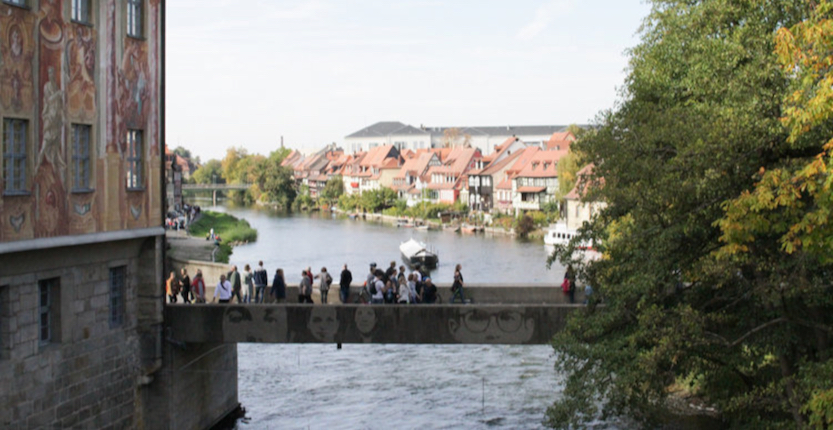
We enjoyed our tourist tour and admired the town hall as the seat of the city council overlooking the water, the coats of arms of the patrician families, "Little Venice", a beautiful corner of small houses from the 15th century.
The Bamberg Symphony Orchestra, a modern theater renovated for 50 million, the international artists' house as a counterpart to the Roman Villa Massimo (scholarship for artists) run by a poetry slammer, the cathedral with the Bamberg Horseman (landmark of the city), an imperial couple and papal tomb and some of the eleven breweries (the district has 76 breweries) – they are all the unforgettable sights and symbols of a strong city brand.