
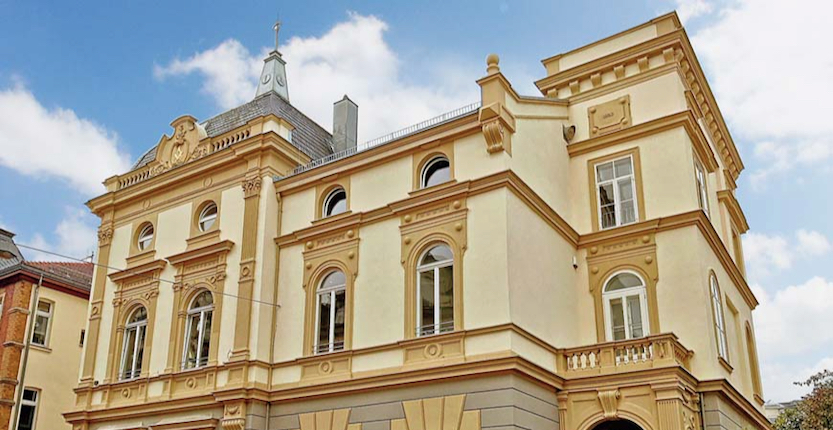
Myths have always surrounded Freemasons – and these have repeatedly been scandalized on the stage of Austrian domestic politics, most recently during the presidential election. Their origins and mystique, their brand and brand management are shrouded in secrecy – but the Brand Club Austria was granted exclusive access for a morning to one of the oldest Freemason lodges in the world. Its Worshipful Master painted a completely different picture of the humanistic ideology behind the secret society. What makes Freemasons a brand?
Fascination Freemasons
Klaus Stieringer, the Master of the Chair of the Bamberg "Freemasons' Lodge of the Regnitz," President of the Bamberg City Marketing Association, Chairman of the SPD parliamentary group in Bamberg, and "German Cultural Manager of the Year 2014," wanted to present himself to us without the myth and without the "fabricated world conspiracy theory" (about responsibility from the French Revolution to American presidents). But simply entering the temple of the Bamberg lodge and the solemn silence amidst the pictures and symbols created a mystical atmosphere.
No wonder – we were the first group of laypeople (non-Freemasons) to be allowed to "meet" in the temple since its founding in 1871, in a newly renovated, windowless room with dimmable lighting, candles, and a throne. "That's because the Bamberg 'lodge' is different, more modern, and more open than others in Germany, Austria, and Switzerland," Klaus explained, "and because a traveling lodge was meeting next door, leaving only the temple free.".
The setting was unusual: We sat in a circle of chairs, the throne in front of us, the place for the brother taking minutes, and next to it, the place for the speaker recording the proceedings (centuries ago, from this position, the day's work for the construction of cathedrals was drawn in the sand on the ground). Behind us, naturally also unoccupied, were the places for two supervisors and the place of the master of ceremonies, who, with his staff, would remind anyone of the proceedings should they forget something (nowadays, for example, the LED light to imitate the rising sun).
Access to a mystical brand: Freemasonry and the Bamberg Lodge
Modern Freemasonry has existed for 302 years, although the first lodges formed in the 12th and 13th centuries as highly specialized stonemasons' guilds. These guilds were capable of building cathedrals. Their members, architects and planners, traveled through diverse political and value systems, working globally. Consequently, they developed a shared set of values: humanism. The focus is on humanity, not on the prevailing value system in a particular geographical area.
The admission criteria
„"You have to be a God-fearing person, but it doesn't matter which God you believe in," Klaus explained to us, describing the first admission criterion. The Bamberg lodge primarily includes Catholics, but also Protestants, Jews, and Muslims. Although religious topics are not discussed, religious representatives are regularly invited to give lectures.
Engaging with topics like philosophy, history, and oneself is unusual in today's fast-paced world. For Freemasons, however, pausing and reflecting on what is happening within and around us has always been central: "Like in physics, many people want to find simple answers to complex questions. Freemasonry doesn't do that, and that's one of the reasons why myths abound," Klaus explained, elucidating the mysterious nature of Freemasonry and quoting:
“You can judge the state of a society by the way its philosophers treat each other. German philosophers take taxis.”
Each lodge experiences it differently.
Despite their inward focus, Freemasons remain consistently engaged with the current social and political situation: As early as 1948, Freemason and Commander Dehler called for bridging societal divides – and especially for inviting nations to dialogue when these divides widen. "That was my predecessor's predecessor, and his words are still relevant today."„
When asked about women's accession to Freemasonry, Klaus explained: "There are already mixed lodges, but also strictly separate women's and men's lodges. The oldest is the Research Lodge, which focuses solely on knowledge gathering and where men and women collaborate as equals." The opening address after the renovation was given by the chairwoman of the women's lodge – unusual for many men. "But branding requires reprogramming – then the men think, 'Well, that works.'"„
Every lodge practices it differently; the Viennese Freemasons would be surprised to see women from the Brand Club sitting in the Bamberg lodge, Klaus remarked: "The Viennese have a long list of words one isn't allowed to use: lodge, Freemasonry. That's fine, because every lodge practices it differently." Freemasonry, after all, has a personal impact.
Permeated by free spirits, creatives, and artists. "I will never tell anyone how to live!" To focus on the humanistic ideals of Freemasonry, powerful symbols are employed:
The symbols and codes for the „Temple of Humanity“
To consciously leave the profane realm and enter the temple, signs and symbols decorate the space.
„We wear top hats, black suits, aprons, and bags. This conscious transition from the profane world to the temple requires symbols – we leave the worries of the world out there.“
Klaus described the codes in the lodge's temple and explained the classic symbols of Freemasonry to us:
-
Angle: "Are we at the right angle for what we are doing?"„
-
Circles (symbols for infinity) that indicate the area in which Freemasons should operate and be active.
-
The symbol for the plumb line: "Look within, are you balanced?", means the here and now, focus instead of inner turmoil.
-
The angle scale: "Are we in the right relationship to ourselves and to others?"„
-
The 24-inch scale: "When do I have to do what?", the work-life balance
-
The hammer blow: the law and order of the system we are in and its hierarchy (no parallel society with its own rights).
-
The number 3: triangle, three candlesticks, the eye with its three directions: wisdom, beauty (inspiration), strength (power for endurance). It is often associated only with Freemasons, but the discerning eye also recognizes the Christian Trinity, Mesopotamia, etc., as a sacred number.
-
A pointed hammer and a rough-hewn stone: the idea is to create a cube from them. "Join together to build the temple of humanity!"„
-
Sword: Symbolically, it secured the construction site. And here, it represents faith in humanism, tolerance, and openness.
„"We meet once a month for ritual work in the temple, with lots of music, dialogues, and symbolism. Fifty to sixty Freemasons enter, bow eastward (the letter G), and the color blue is everywhere. Three candles represent wisdom, beauty, and strength—the order in which they are lit has symbolic meaning. Then the LEDs are slowly turned up, and we open the day's work. When the day's work is completed, we extinguish the candles. For example, it might be said: 'May the light of wisdom continue to shine.'"“
These identifying marks and symbols are equally essential in communication and branding. Klaus took a clear stance: „"The conspiracy theories arise because the Freemasons do not communicate with the outside world. It is advisable to examine the deeper ideas of the Freemasons."“
A lodge can only be entered with a sign of recognition. These signs originally arose to protect against industrial espionage. Entering an apprentice lodge requires the password of the lodge and the rank (apprentice, journeyman, master) as well as the symbol combination ("And for that, you must understand the symbols!").
When someone says "it's raining," it means they are not protected from the elements. This meaning stems from the fact that in earlier times, access to churches was only possible via the roof. Translated, this secret language of Freemasons means "a non-Freemason is present.".
On the philosophy of the "brand": tasks, secrets and secrecy
„Know thyself,“ Klaus described the guiding principle of Freemasonry, which means: „Question your beliefs. We are the product of the thoughts of others – that brings us to the symbols that advertising also uses. Only when you are aware of this can you question the system and rise above it.“
Philosophical topics are discussed in Freemason lodges. Klaus explains: "The kind you wouldn't discuss outside. The meaning of life, the reason we're here – that was discussed just last week. Why are we allowed to live here and not in a Syrian mountain village? Are we making the most of being part of 1% by advancing our society?"„
„If you ask a Freemason what he believes in, he often says, ‚That’s a secret.‘ At the same time, the conscious process of slowing down, the time for concentration and reflection, is something very personal and difficult to explain,“ says Klaus. „The meetings are meant to stop time, to remind us what we can do. And of course, the social aspect and the camaraderie are also central – as in any club.“
For Klaus, secrecy means turning one's gaze inward, developing a strength that is not communicated. "The influence of Freemasonry is never explained. But: we are not involved in 9/11 and we are not responsible for the refugees. We work for ourselves, we are closed off. In our social responsibility, we should ask ourselves, like Goethe, Voltaire, Leonardo da Vinci, Izaak Rabin, Atatürk, or even Karl Heinz Böhm: What can we improve?"„
Membership costs €240 per year. But how does one become a Freemason?
There is no recruitment process. Two people are admitted to Bamberg's lodge each year, and the opportunity is only granted to those who contact the lodge to be invited to guest evenings with short presentations. "We don't do any spiritual exercises, yet we often get esotericists, light beings, and tree huggers. We don't have a holy grail," Klaus laughed.
The initiation ritual involves a ball-rolling ritual: „Each member of our brotherhood has one black and one white ball. If more than three black balls are placed, then initiation is excluded – if more than three, then the brothers who rolled the black balls have 48 hours to explain their motivation.“ Klaus then decides, for example, against a swingers club owner, because he was not a „free man of good repute.“.
„"Here, you don't have to give blood, undress, or make a sacrifice; instead, you enter the room blindfolded, so you don't know who is there and have to trust who is guiding you." After the novice has been "deprived of his metal and his decorations," meaning he has surrendered his jewelry, one trouser leg and the collar of his shirt are rolled up (to check that no jewelry is hidden), and then he is received with a solemn speech.
It takes place in a "dark chamber" with a table and a skull and refers to the hourglass (the time you have left) and the holy book (representing the community's shared values; in Germany and Austria, the Bible; in France, a blank white book; in Turkey, Quranic verses). The brothers form a chain around him (similar to when a member is buried), and he receives the insignia.
„"You can find friendship and solidarity, but nothing that you can use in your professional life. Business Freemasonry is very unpopular with us; anyone who wants to do business here is very quickly excluded."“
For Klaus, the core message is this: "Be aware every day that your life is finite. Make something of it." The stages of this realization can be explained by the members' so-called "age." "No one can promise to become a better person. But we want to live in a society where people are willing to take the initiative and work on themselves."„
The Freemasons are the last remaining symbolic and mystery society. Klaus explained to us why Freemasonry is still needed today in a political context: "Today we are once again facing currents that we thought could never happen again."„