
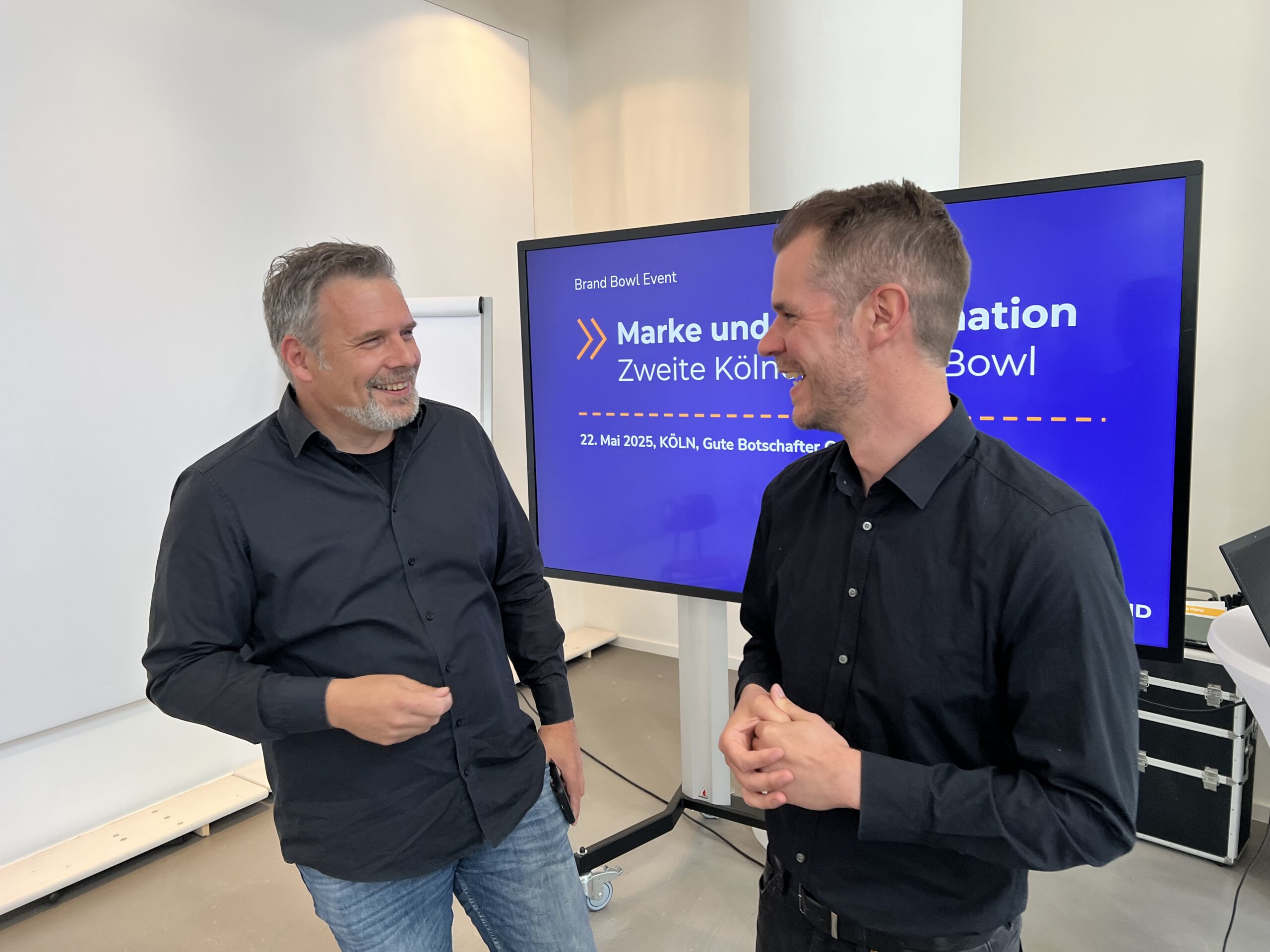
„"Brand and Attitude" – that's the Brand Club's theme for the year. The choice is no coincidence, as the topic is very prominent in professional discussions. But just because the topic is currently on everyone's lips doesn't mean that everything under this heading truly embodies attitude.
The common argument goes like this: When brands take a stand on social, environmental, or political issues beyond their core business, they demonstrate conviction. This type of communication sharpens the brand's public profile because the brand stands for values that are important to people. And, as a bonus, they're also doing some good.
Is that already a stance?
And does that strengthen the brand?
What exactly constitutes an attitude?
And when should corporate brands justifiably communicate their stance?
We identify 3 points of reference for brand and communications managers:
1. Attitude entails responsibility
There's nothing wrong with thousands of companies calling for voter participation on social media. However, this has nothing to do with branding or taking a stand. It's simply "going with the flow." Such lip service won't get you burned, but it also won't create a lasting connection with your brand – because what everyone else is doing doesn't differentiate you. And none of it is perceived as a stance, because a true stance only becomes apparent when faced with resistance: when it incurs social or other "costs.".
For example, if Google has implemented its DEI (Diversity, Equality, Inclusion) rules in recent years according to common sense, this doesn't necessarily demonstrate a commitment to the principles. However, if the company now refuses to budge despite pressure from Washington, this does show a commitment to the DEI principles. Similarly, when Patagonia was transformed into a foundation dedicated to combating climate change, even though much higher profits could have been achieved through other means, this demonstrated a commitment to climate protection. But simply publishing a sustainability report, which it is legally obligated to do anyway, does not.
When brands are embroiled in scandals, they also take a stand – just in a slightly different way: The banking crisis revealed that many financial institutions had deliberately given their customers incorrect advice in order to maximize their profits. A clear stance in favor of short-term profit and against customer well-being. Taking a stand in itself is therefore neither positive nor negative. That only becomes clear when considering what a stance is taken for and from what perspective it is evaluated.
According to this definition, attitude is the commitment to follow one's words with actions and to stand up for something, even if this may involve disadvantages.
What does this mean for companies?
There's nothing wrong with a company participating in "attitude campaigns" if the goal is commendable and doesn't contradict the brand. But brand managers shouldn't expect anyone to remember it in six months.
Anyone who seriously wants to examine their own stance must clarify what they would stand for in a crisis: What sacrifices would they make, important investments would they accept, criticism would they let slip through their fingers, or economic opportunities would they be willing to forfeit? Because in a pinch, words must be followed by actions – otherwise, the damage could outweigh the benefits.
2. Attitude as a principle
The principle that words must be followed by actions implies that stance cannot be understood as a purely external campaign issue. Stance must act as a guiding principle internally, in order to be consistently and convincingly communicated externally when necessary.
What does that mean in concrete terms? A stance isn't a detailed rulebook, but rather a guideline for decisions and actions within a company. A brand that sees itself as particularly philanthropic, for example, can afford a child labor scandal in its supply chain even less than other brands. It is also more obligated than others to, for example, take a stand against human rights violations and critically examine trade relations with the countries involved.
All of this has implications. If a brand wants to adopt such a stance, decisions must be made, processes set up, controls established, and much more.
In short: A stance is only possible if it is anchored organizationally and the company's employees (especially management) act accordingly.
But therein also lies the strength of attitude: As an often unwritten set of rules, it forms the framework for employees of what is possible in the company, what they can rely on, and as a cultural link between values and actions, it offers a basis for identification: It unites the employees behind the brand.
Without internal anchoring, a brand's stance will not be visible to the outside world or effective with customers.
What does this mean for companies?
Taking one's own stance seriously means involving employees and especially company management. Otherwise, one risks paper tigers and lip service, but no effective results.
3. Develop an attitude from the brand
Taking a stand requires a lived commitment within the organization, but considering the brand's audience, the question inevitably arises: How much of a stand can a brand tolerate? How much can it tolerate without abandoning its own area of expertise, its own business, and its own value creation in an unconvincing way? For example, does every potato chip manufacturer worldwide have to take a stand against climate change – or can a smaller scale suffice?
The key to answering this question lies in reflecting on the very foundation of one's existence. Brands are economic actors that satisfy customer needs in the market. They are not NGOs, political parties, or public institutions. Therefore, they shouldn't pretend to be. Indeed, the very nature of a brand's activity is inconceivable without a stance; for example, a stance towards its own product, its employees, its customers, and so on. Once it's clear what characterizes this intrinsic stance, it becomes quite easy to deduce what it stands for.
Reinhold Würth demonstrated how this can be done. He caused a stir in 2024 when he urged his employees in an open letter not to vote for the AfD. In doing so, he not only fulfilled the aforementioned criterion of doing more than strictly necessary, but also provided a very credible explanation.
„"We have so many employees with a migration background. If they all stopped coming to work, it would simply mean the collapse of the company."“[1]
It is precisely because he doesn't pretend to be, for example, a politician, but remains authentic in his role as an entrepreneur, that it comes across as convincing.
What does this mean for companies?
Companies inevitably represent a stance through their brand(s). The first step, therefore, is to identify what this stance entails, how it should be evaluated, and how far it extends. This quickly clarifies what one should, or even must, stand for. It also reveals the limits of one's own stance. From this position, clear decisions can be made, enabling effective business and social action.
[1] https://www.focus.de/politik/deutschland/unternehmer-schrieb-brief-an-die-mitarbeiter-wuerth-raet-von-afd-wahl-ab-wuerde-den-zusammenbruch-des-unternehmens-bedeuten_id_260228795.html