
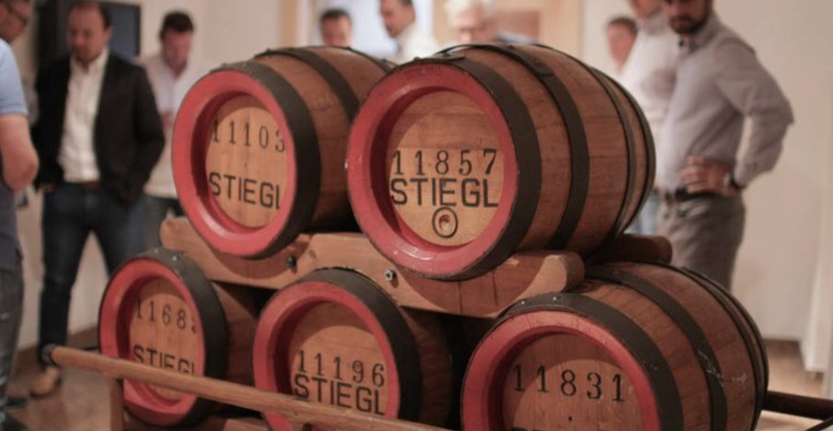
Brewing at its finest
On a wonderfully sunny July morning, Dr. Torsten Pedit, Head of Marketing, welcomed the BrandDay participants to the Stiegl Brewery World and, as the first of four Stiegl experts, offered surprising and – even for brand managers without a beverage range – deep, inspiring insights.
What the 750 employees tell their families and neighbors at home is more important than a Facebook post or a newsletter, Dr. Pedit declared at the launch. If they were to spread negative things about Stiegl, no marketing activity could undo that. Therefore, the employees are his top priority.
The internal training of new colleagues in the marketing team, for example, begins with a three-month induction phase: on the road with the beer supplier on the truck, in the bar service with a screwdriver in hand.
The advantage: Marketing professionals build their network from the outset and learn to understand communication rituals. For example, today there are specialists for the restaurant industry and others for retail; previously, it was one and the same team.
Beer delivery drivers as good guys & „slowing down“ in the beer wagon
Employees in telephone sales, technical service for the installation of dispensing systems and 200 beer drivers with 120 trucks also form a large team in the „brewery world“.
„"The beer delivery driver is the most important one because he has the most personal contact with the customers, several times a week. He's 'the good guy' to the pub owner because he doesn't negotiate prices and keeps coming back – he knows where the key to the cellar is and where the change is." Pedit insisted that beer delivery drivers used to be overlooked in communication. Until they were included in decision-making, the pub owners were the ones consulted. Today, beer delivery drivers participate in logistics meetings and contribute information directly from the pubs. Outside of these meetings, it's more complicated for managers, Pedit explained: "If you want to listen to the beer delivery drivers, you have to meet them at 5:30 a.m. for a snack. But if you build a foundation of trust, you can learn a great deal from them." Couldn't that be done in writing? "We can't reach the beer delivery drivers by email, and we don't want to, because it wouldn't show them any respect. They are our most important ambassadors, they know that, and that's why they are paid according to the collective agreement."„
The beer delivery drivers in lederhosen are also unusual. Heinrich Dieter Kiener, the brewery owner, didn't want to end the tradition of delivering beer by horse, but rather continue to afford to employ two drivers, Pedit explained: "We still have several horse-drawn carriages in our logistics fleet that deliver truly regionally, in all kinds of weather. The drivers wear the old leather outfits. Because people love the 'slow pace', we've even made videos about it. We raffle off the chance for customers to ride along in the carriage – very simple things with an impact."„
After 500 years of tradition, it's time to get "edgy".
The brewery "Gstätten bei der Stiegen" was founded in 1492 in the center of Salzburg. The brand name is derived from this staircase. The Huemer brewing family, now Kiener, has never questioned this brand name. The logo also existed as early as 1493 as a guild sign and on old coats of arms featuring the brewmaster's insignia with embellishments – it was simply simplified over time.
Over the past 500 years, the brand has naturally evolved. Its DNA is rooted in tradition and culture, which is why the mission of recent years has been to make it more modern, younger, and sexier: "Also due to the fact that the CEO is now thirty instead of sixty," explained Marketing Director Dr. Pedit. "Every brewery has its Maypole festivals and lederhosen, which is why Stiegl, for example, sponsors the Life Ball, which at the time was deliberately edgy and unconventional for the rural population.".
„"Our strategy is premium."“
„If you want to grow in Austria’s 50,000 restaurants and bars, you have to take some of the market share from other brands. Our strategy is premium: we don’t jump on every bandwagon,“ Pedit sums it up, and shares some insights gleaned from observation: „I was standing in a corner of a supermarket once, watching people buy Stiegl. One guy bought two 24-can packs of a cheaper competitor for 39 cents each. I figured he certainly wasn’t a Stiegl customer and dismissed him as someone who doesn’t appreciate the finer things in life. Then he put a six-pack of Stiegl Goldbräu in his cart, and I was confused because he was paying the same price for six bottles as for 24 cans. He said the cheaper beer was for his football-loving friends and the Stiegl Goldbräu was for himself.“
Market share, export strategy & shandy market leader in Canada
Stiegl produces 1 million hecotoliters annually – that's 300 million small glasses – the world's largest brewery in China is 600 times larger by comparison.
The top three beer-consuming countries are the Czech Republic, Germany, and Austria – although in Austria, light beers (Radler) and non-alcoholic beers are particularly popular, while sales of lagers and Märzen remain very stable. The main competitor, Heineken, holds a market share of 651,030 in Austria with its beer brands, while Stiegl currently has a market share of 161,030.
Stiegl's export share is 101,000 tons, and it was only ten years ago that an export strategy was developed. Today, there is a dedicated team for the USA, Canada, Italy, Slovenia, Sweden, and "eccentric" ventures like 20 hotels in Sydney and 10 restaurants in Shanghai. "We are aiming for 151,000 tons – but with good added value."„
Stiegl's success in becoming the market leader for its Radler in Canada (where it sells more than in Austria) was by no means due to a disruptive strategy. "We first went over there with Goldbräu and then tried the Radler. The success was a bit of a fluke – because buyers in the highly regulated market were interested in a light Radler, and we were the first to offer it," Dr. Pedit explained with satisfaction. Stiegl accepts that Budweiser copied their Grapefruit Radler exactly after five years. Stiegl's creative brewmaster, Markus Trinker, then led the Brand Club group on a tour of the brewery, including the barrel aging cellar (where specialty beers are tasted) and the modern brewhouse.
First impressions: At Stiegl, the beer is given the time it needs, but automation has long been standard practice. However, for Gault Millau's Brewmaster of the Year, it's not just about process control in fully automated systems like at other large breweries. Direct contact with the farmers is crucial for Markus Trinker's beer quality: The raw material varies from year to year, but the beer should always taste the same. The challenge, therefore, lies in coordinating with the farmers early on.
Stiegl is characterized by its full body, high drinkability, and bitterness, he explained: "You can easily go up or down with the hops – depending on the raw material. But Stiegl is always recognizable."„