
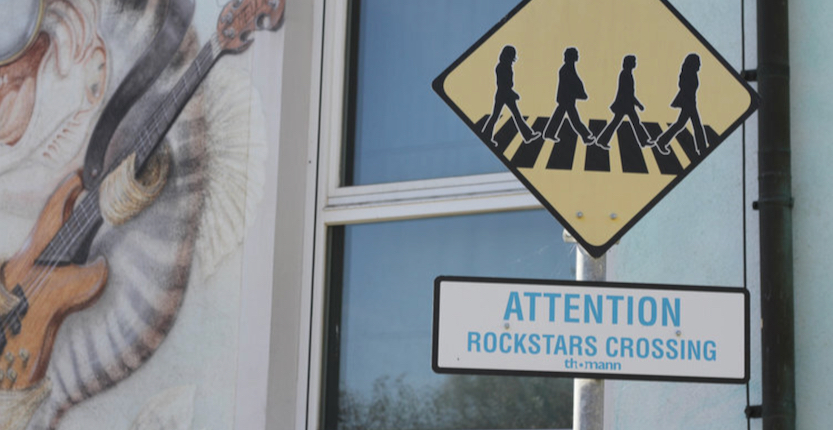
The man who hit Amazon
Musicians from all over the world shop at Hans Thomann. The instrument maker and retailer was dubbed "The Man Who Beat Amazon" by brand eins magazine. 1,400 employees and 9.4 million customers embody the "Thomann spirit," emanating from his independent family business – the largest music retailer in Europe – in Treppendorf, Bavaria. At the Brand Day event, the Brand Club had the opportunity to conduct exclusive interviews with the CEO, the Head of Marketing, and the Head of Service, gaining an insider's perspective on the extraordinarily successful THOMANN brand.
Hans Thomann, with his instrument business, has not only developed over thirty in-house brands, but this year achieved €830 million in revenue with a €651 billion export share, along with €8 billion EBIT and €8 billion growth. What makes the THOMANN brand so special? The "store," as Hans Thomann calls the gigantic shop at the headquarters, is an experience in itself: "When big music stars come, it makes me and my employees proud." Products worth €100 million are on display here.
„"Sales are low compared to online, but I would subsidize the store any day!" THOMANN went online back in 1996 and has since invested in 32 websites with engaging content. Because it presents high-quality content for music lovers and reaches tens of millions of people every month, this huge SME has managed to remain independent of Google and Amazon. But let's start from the beginning.
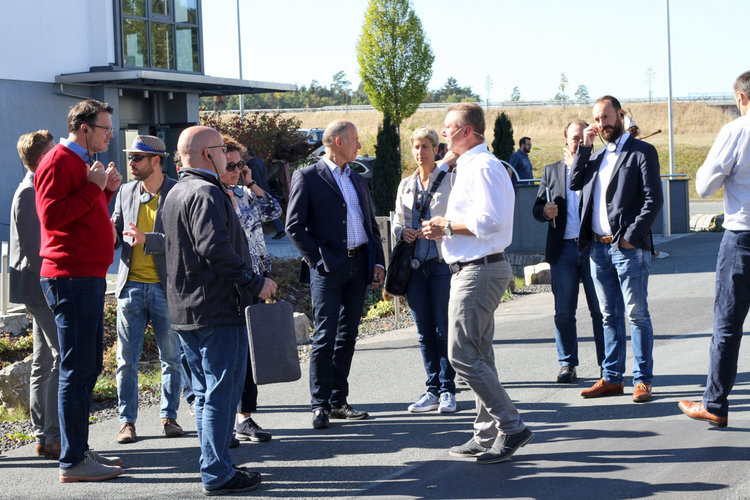
Hans Thomann, Managing Director and CEO, welcomed us in the administration building. 1,350 employees work at this location, with 140 of them in marketing alone (including external offices).
In 1968, Hans Thomann, a trained instrument maker specializing in wind instruments, began expanding his parents' business. Twenty years ago, the idea was to realize large-scale installations, such as in opera houses. While building loudspeaker systems for the Rolling Stones' rental company was one thing, inspiring solo entertainers in their own world was quite another. "Back then, I expected the transfer of knowledge to be more significant," Hans Thomann said, describing the development of his brand. He therefore focused on service: "The call center offers consultation and sales in 18 languages. And our employees are happy to come here to Bavaria: good communication, good treatment, good pay." Employees who, for example, play guitar and provide advice in that area, also have access to a sales department.
“We are a music store, not cardboard box pushers! My hobby is visiting specialized shops.”
— Hans Thomann
Human factor and service competence instead of Amazon anonymity
The demands of retailers, especially younger ones, are high if they want to compete with Amazon. Therefore, Thomann invests in quality control with 60 employees, which is essential, considering they ship out 900 guitars a day, for example. But guitars are just one (huge) department of the music store. The product range also includes lighting, digital mixing consoles, and moving lights (starting at €300, previously unaffordable at this quality). "Our employees come from the event industry or were on tour and joined us at the age of 40. You get advice from professionals!" enthused Hans Thomann during a stroll through his store. The tour continued to the loudspeaker systems, where 90 employees alone offer sound reinforcement tests for concert halls, generating €30 million in revenue. The Brand Club then proceeded through the departments for DJ equipment, digital mixing consoles (We have a 50% increase in revenue for analog synthesizers; people want to turn knobs again!), studio monitors and microphones, headphones programmed in-house, accordions, and finally pianos from grand pianos to upright pianos, and lastly a completely new product group, handpans, which alone generated €1 million in revenue in 2017.
The recipe: tight margins, cool marketing, 31,000-per-3,000 growth because online access to 250,000 items is available in the system. 6,000 different electric guitars alone offer a gigantic product range. People love the advice and travel from all over Germany to the world's largest music instrument store. "We invest €40 million annually in freight, €40 million in labor costs, and €40 million in marketing: €120 million disappears in no time." For 26 years, there was a legendary summer festival on the premises. For Hans Thomann, this huge event became too risky, so they finally held one last big party with 10,000 people.
„"We're finished when the customer is satisfied."“
The head of service, a former IT manager, demonstrated this to us and guided us through the three levels of customer service – from the help hotline (via email, chat, and telephone) through the product categories to the repair workshops. The primary goal of customer retention is focused right from the organizational structure: the quality assurance team is integrated into customer service to enable a rapid response when a product category experiences a high volume of returns.
The "small" logistics department of the service center alone receives 1,500 packages per day. And things move quickly: "If, for example, a Gibson arrives with a broken neck, it only takes a week with glue and lacquer before the customer can play again." All classical instruments are repaired here, as well as all electronic instruments if they were purchased from Thomann. Items sent out for repair can remain with partners for 10 days – after which a reminder is sent to the repair partner. If they are unable to resolve the issue, Thomann replaces the device.
Orders and shipments are displayed live on a monitor. Arrows crisscross Europe. The logistics behind checking and shipping all orders are gigantic.
“At the beginning of the 2000s, we produced 800 products per day; today we are at approximately 1000 pieces per hour!“
The largely automated warehouse offers 80,000 storage locations, with pallets and boxes rattling into the shipping center. Their destination is the packing stations, where employees place the products into appropriate boxes. Manual order picking by forklift drivers is rare; most of the work is done by towering automated systems. Dominic Wagner, Head of Marketing, wanted to kick off an interactive afternoon with us and, together with Hans Thomann, first prepared fresh espresso for everyone.
The Thomann brand stands for credibility, modernity and team spirit.
„We don’t rip off our customers; that’s more important to us than profit,“ Hans Thomann told us first when asked about his brand positioning. And the marketing director added: „We have three photo studios because we want customers to be able to trust our online shop. If someone buys a red guitar, it shouldn’t look orange in the online shop.“
Throughout the history of online retail, Thomann learned to find its unique selling proposition (USP): "321meins started with a large product range and good prices, then in the late 90s it was all about perfect logistics, since the iPhone in 2007 people have wanted convenience, and today it's social shopping: What do others think about the product?" Social shopping brings growth thanks to an authentic communication strategy. The key elements are building a community and facilitating exchange among customers.
„We are also a media company!“ Dominic Wagner proved with impressive figures: Thomann alone has 22 million video views on YouTube! Hot Deals is the title of the customer magazine with a circulation of 7 million copies in 8 countries, the music network around thomann.de communicates tutorials, lessons, news about concerts, and various specialized online magazines communicate with everyone from small bands to electronic musicians.
Banner advertising space is available – but the focus is on authentic content. Media outlets must generate independent profits. Customer reviews and ratings after purchases, driven by coupons and reminder emails, are a boon for Dominic Wagner: Customers often write reviews proactively, without any prompting.
Community managers publish regional content in the respective countries. Two "roving reporters" zip around the location, gathering the atmosphere, photographing stacked goods, and receiving a lot of positive feedback because customers see Treppendorf as a mecca for musicians.
Another topic at the brand day was Swarovski's collaboration with the tourism industry to generate more added value for the country. A current initiative aims to encourage Chinese and Indian visitors, who typically only visit as day tourists, to stay for one or two nights. This collaboration with the tourism industry encompasses not only Austrian and Tyrolean tourism boards, but also Munich Airport and Bavaria Tourism, as well as competitors such as Neuschwanstein Castle, BMW Welt Munich, and tourist destinations in Switzerland. The seven social media teams are located in Germany, Spain, Italy, the Netherlands, and Finland, operating regionally: "Facebook ad publishing is significantly cheaper in Southern Europe, while organic reach is hardly effective in Northern Europe anymore." The team for France works from Treppendorf. Social media promotions, on the other hand, are managed from the Aschaffenburg office. Facebook has been used seriously for five years, blending regional content with content from Treppendorf.
“Social natives are people in their mid-twenties who can write, take photos, edit videos, and independently publish content for the markets.” „We don’t work very strategically there, but rather in a more hands-on way. Most of the people are musicians and just want to get on with it instead of reading strategy plans,“ the marketing manager described his social media team. Topics like personal development and what music can do for people are addressed in the content, as are some flippant clichés. The „Women belong at the hearth“ campaign only drew heavy criticism two years later, when the ##metToo movement was a major issue. The company hopes to continue its success with the masculine-focused campaign. The in-house brands were neglected because they sold themselves thanks to their low prices – but now there are product managers who take care of one in-house brand after another.
The Berlin agency Dirk and Philip (also representing Jägermeister) is responsible for the major "Power of Music" campaign. "They also send ideas for social media content, contests, or Christmas campaigns." However, much else is handled in-house because speed is crucial, especially with social media – and Dominic Wagner argues that the way agencies are structured is a problem: "The contact person takes time to get a proposal, then there's a creative director or art director involved, and if someone's on vacation, a lot of time is lost. Plus, someone always quits after we've established a good relationship. That's why we always work with a small Hamburg agency."„
International competition and Thomann's pricing: tough! Hans Thomann went into detail about their pricing: "We already offer digital pianos at low prices. How do we manage that? Ordering from China costs Thomann $210, the packaging costs €20, and nothing can go wrong. For €550, you can already get a pretty good digital piano from Thomann because containers of 3,000 units are ordered, eliminating the need for a middleman." The same applies to microphone stands; 14,000 of them fit in a single container. "For us, research means that an employee uses a spider machine to analyze competitors' prices and then sets our own," Hans Thomann explained, describing his pricing strategy.
Marketing manager and father Dominic Wagner offered insights into the customer groups: „Among children, more girls learn instruments and make more music, but in their teens they often lose interest, while boys stick with their instruments. Men, on the other hand, are more prone to collecting and therefore buy a new instrument more often than women. At the same time, a customer who buys a Steinway grand piano won't return to Thomann for the next 10 years.“